Forgotten Requiem
C++
GAS
FlowGraph
AI
Systems
Blueprints
UI
Editor Tooling
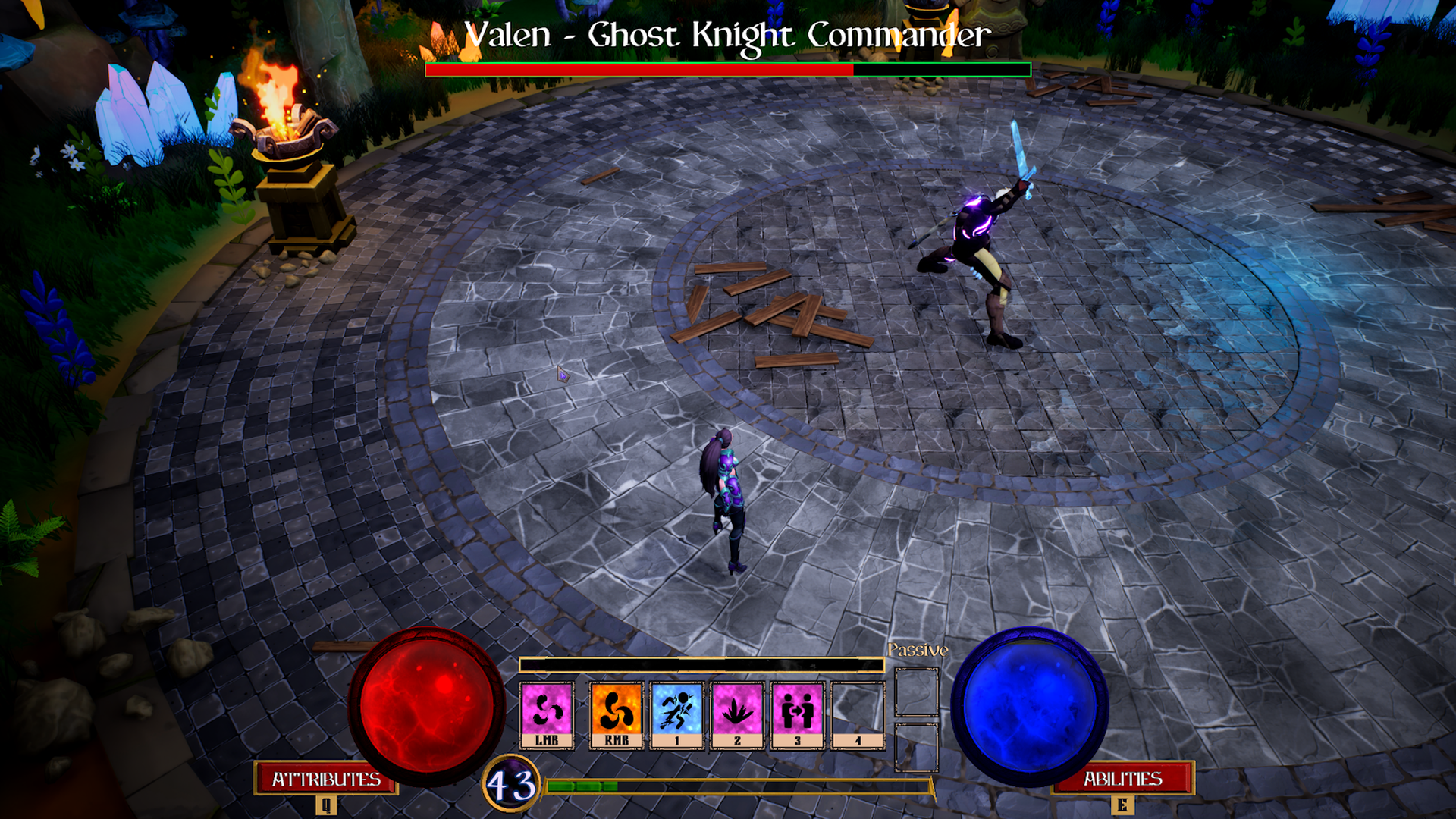
Forgotten Requiem is a singleplayer Diablo-like Action RPG (ARPG) built in Unreal Engine using C++ and the Gameplay Ability System (GAS).
👉 Wishlist “Forgotten Requiem” on Steam (Coming Soon)
🛠️ Key Technical Architecture & Systems
1. FlowGraph Quest & Cinematic Dialogue
- 25+ custom C++ Flow Nodes (dialogue, dialogue choice, cutscene, save game, spawn/alter enemies, apply gameplay effects, convert NPC to ally, etc.) drive a non-linear quest/dialogue graph that maps progress to GAS gameplay tags and player state, with a data-asset-driven camera preset/focus/shot system giving each dialogue node its own cinematic framing.
2. GAS Damage & Debuff Pipeline
- A central
UGameplayEffectExecutionCalculation(UCpp_ExecCalc_Damage) resolves Physical/Fire/Lightning/Arcane damage against per-type resistance attributes, applies radial falloff damage from an origin/inner/outer radius, and rolls elemental debuffs (Burn, Shock, Stun, Curse) plus several boss-unique status effects (Pandemonium, Pyre of False Comfort, Djinn’s Conduction Armor, Neural Dazzle) off a damage-type-to-debuff gameplay tag map.
3. Data-Driven Boss AI
- A custom
UBTTask_BlueprintBasetask (UCpp_BTTask_BossBehaviorTask) turns boss combat into an author-defined state table: each combat state (melee/ranged combos, special attacks, stun, dodge, phase transform) lists distance-based conditions (in-range/closer-than/farther-than, or a Blueprint-custom predicate) that pick the next state — reshaping an entire boss fight is a data edit, not a C++ or Behavior Tree graph change.
4. Spatial (Ambient) Dialogue System
- A data-driven system, independent of the main quest dialogue, where NPCs pick weighted in-world lines governed by a playback policy (repeatable / once-per-activation / once-per-combat / once-per-save with save-tagged persistence, priority interruption, anti-immediate-repeat).
- A polymorphic
USTRUCT-based trigger library (health-below-threshold with rearm, nearby-hostile-count with rearm, damaged-by-player, ability-used, ally-defeated, timed interval, gameplay event) covers combat and exploration contexts separately, so reactive barks need no manual per-encounter scripting.
5. Engine-Replacement Gameplay Subsystems
- Shared Timeline Subsystem: A tickable world subsystem replacing per-actor
UTimelineComponentusage with pooled, curve-driven timeline tasks (duration/ratio/loop/reverse modes) exposed to both C++TFunctioncallbacks and Blueprint delegates. - Camera Subsystem: Composes independent base/offset values (mirroring GAS’s base/current attribute pattern) for zoom, pitch, and FOV on top of a third-party cine-camera plugin, each interpolating on its own timer.
- Actor Pool Subsystem: Generic object pool for projectile/VFX actors that spreads pooled-actor destruction across frames to avoid a spike.
- Ally Subsystem: Respawns fallen companions off-screen using async line-of-sight traces and navigation reachability queries, with separate in-combat/out-of-combat respawn delays.
6. Automated Test Harness & CI-Style Runner
- A standalone test plugin (compiled out of Shipping/Test) layers Epic’s Automation Test Framework, CQTest, FunctionalTesting, and AutomationDriver over dedicated test game mode/instance/world fixtures, so every suite runs against disposable fixtures instead of production save slots or levels.
- Real input, not mocks: a UI test drives the actual spell menu through
IAutomationDriverModule’s async driver — moving the cursor to a rendered button’s hit-tested screen position, clicking it, then injecting a raw keyboard press through Slate — and asserts production Enhanced Input bindings activated the ability the UI just equipped. - Runtime Flow-graph fixtures: a quest test builds a
UFlowAssetgraph from scratch via reflection (FindFProperty/ContainerPtrToValuePtrto wire node connections that aren’t exposed to C++), fires 260 kill notifications through it end-to-end, and verifies completion state round-trips through an actual disk save — exercising the exact production Flow nodes, not stubs. - Functional-test actors: a checkpoint test spawns a real character and trigger volume and asserts on an actual physics overlap event, not a simulated one, checking save-to-disk and repeated-entry behavior.
- Headless orchestration: a PowerShell runner launches
UnrealEditor -gameunattended, tails the live log file by holding a shared read handle while the engine process writes to it, streams pass/fail per test case to the console in real time, and emits HTML/JSON reports plus engine-side raw results — recovering partial results and marking the rest “not run” if the process crashes or times out.
7. Custom Unreal Editor Tooling
- Interactive Viewport Gizmos:
FComponentVisualizersubclasses with customHComponentVisProxyhit proxies let designers click-and-drag individual patrol points directly in the viewport (HandleInputDelta/GetWidgetLocation), plus a dedicated spawn-radius visualizer for enemy spawners. - Blueprint Compiler Extension: A
UBlueprintCompilerExtensionhooksProcessBlueprintCompiledto statically flag unsafe ability-delay usage at compile time — static analysis running inside the Blueprint compiler, not just runtime checks. - Custom Flow Graph Slate Nodes: Hand-built
SGraphNodewidgets (SCpp_FlowGraphNode_Dialogue,_DialogueChoice,_StartDialogue) swapped in via customUFlowGraphNodesubclasses so dialogue trees are readable at a glance in the graph editor. - Detail Panel Customization: An
IDetailCustomizationsurfaces patrol data on the owning character’s details panel with custom row widgets and a clipboard transfer path that copies a patrol route struct from the component straight onto a Flow node.